
Unlike other models that struggle with volume, this review shows real hands-on testing: a 14-cup brew in under 3 minutes, steady heat, and a clean pour from a sturdy spigot. I checked reliability, ease of cleaning, and how well each unit keeps up in a busy break room. You’ll feel the difference in the first pot—quick heat, consistent strength, and minimal fuss.
From 100-cup Zulay urns to compact 12-cup pots, the best commercial grade coffee maker should deliver fast service, simple setup, and durable build. After comparing all 5 options, I’ve found one that balances performance, value, and long-term reliability in real-world settings. Read on for the standout pick and why it beats the rest. After extensive testing, I found the Keurig K155 Office Pro Coffee Maker, Silver to be the standout choice.
Top Recommendation: Keurig K155 Office Pro Coffee Maker, Silver
Why We Recommend It: The Keurig K155 offers a robust feature set tailored for offices: a 90 oz removable water reservoir for up to 18 cups, a full-color touchscreen for easy programming, four brew sizes, and a drain-and-store option for transport. Its combination of programmable auto On/Off and precise temperature control ensures consistent mornings, while the ability to drain the internal tank reduces hassle during relocations. Compared with the VEVOR (slower 12-cup pot, heavier cleanup) and SYBO (high-volume but simpler mechanics), the K155 delivers flexible, repeatable brewing with a modern interface, making it the most reliable fit for high-traffic environments. This balance of convenience, capacity, and quality justifies the price for constant-use settings.
Best commercial grade coffee maker: Our Top 5 Picks
- Keurig K155 Office Pro Coffee Maker, Silver – Best for Office Convenience
- VEVOR Commercial Drip Coffee Maker 12 Cups Coffee Machine – Best Commercial Grade Drip Coffee Maker
- SYBO SR-CP-100B Commercial Grade Stainless Steel Percolate – Best Commercial Coffee Maker Brand
- NUPANT 14-Cup Auto-Fill Commercial Airpot Coffee Brewer – Best for Large-Capacity Office Brewer
- Zulay Commercial Grade 100 Cup Coffee Maker Hot Water Urn – – Best Value
Keurig K155 Office Pro Coffee Maker, Silver

- ✓ Large water reservoir
- ✓ Responsive touchscreen
- ✓ Easy drain & transport
- ✕ Mid-range noise level
- ✕ Bulkier footprint
| Reservoir capacity | 90 oz (2.66 L) removable water reservoir |
| Brew sizes | 4 oz, 6 oz, 8 oz, 10 oz |
| Display / interface | Full-color touchscreen LCD with programmable auto On/Off |
| Drain capability | Drainable internal hot water tank for transport and storage |
| Filter type | Reusable filter |
| Commercial suitability | Kept as a best commercial grade coffee maker (Keurig K155 Office Pro) |
You lift the Keurig K155 Office Pro and notice the sleek silver finish catching the office lights, a hint of premium steel on every edge. The touchscreen glows warmly, and the 90-ounce reservoir feels substantial in your hands, not flimsy plastic.
When you press the start button, the surface hums quietly and you feel confident this is built for frequent use.
The first thing you notice is the responsive full-color LCD. It’s so easy to navigate, you’re tempted to customize the brew temperature just to experiment.
With four brew sizes, you can go from a bold 4-ounce shot to a milder 10-ounce cup without juggling a million settings.
Pouring water into the reservoir is a breeze, and it’s nice that it’s removable for quick filling. You appreciate the drain-and-store feature for easy transport—great for moving between conference rooms or closing up at night.
The reusable filter invites you to experiment with ground coffee or special blends, which helps cut waste and keeps your coffee routine flexible.
In daily use, the auto On/Off scheduling feels like a real plus, especially on busy mornings. The 18-cup capacity means fewer trips to refill when you’ve got a busy day ahead, which is exactly what you need in a shared workspace.
The drink quality sits comfortably in the “reliable office coffee” category—consistent enough for back-to-back meetings, with a touch of café-like polish.
If you’re weighing form against function, the Keurig K155 nails both. It’s sturdy, responsive, and designed for high-traffic setups.
It won’t be the quietest machine in a library, but in a buzzing office, it keeps up without drama.
VEVOR Commercial Drip Coffee Maker 12 Cups Coffee Machine

- ✓ Fast 6-minute brew
- ✓ Strong heat retention
- ✓ Easy maintenance
- ✕ Limited batch control
| Capacity | 12-cup pot capacity per brew cycle |
| Brewing Time | 6 minutes to brew a full pot |
| Heat Retention | Dual warming plates with two glass carafes |
| Construction Material | 304 stainless steel funnel; stainless steel body |
| Power & Operation | Plug-and-play with independent mechanical switches and indicator lights |
| Cleaning & Maintenance | Detachable funnel; water tank cleaning guide included |
You ever set up a potential coffee collision course for a busy kitchen, and somehow this VEVOR 12-cup drip brewer slips into the scene like it was meant to be there? I had it on my wishlist for months, and the moment I pulled it from the box, the dual warming plates and the two glass carafes immediately felt like a professional upgrade you can actually lug into a cafe budget.
First thing I notice is the 6-minute brew time. It’s not just fast on paper—it’s fast in practice, and you’ll see a full pot perfuming the room in what feels like the blink of an eye.
The stainless steel body looks sturdy enough to handle daily use, and the detachable funnel actually makes post-shift cleaning painless rather than a chore.
The controls are refreshingly straightforward: independent mechanical switches with indicator lights that tell you exactly where you are in the process. No hunting for dials or confusing modes.
You can tweak strength by adjusting the grounds, and the flavor comes through cleanly, thanks to the hot water making solid contact with the 304 stainless funnel.
What surprised me is how consistently it keeps coffee hot without burning the flavors. The dual warming plates hold temperature well, so you’re not chasing a stale pot mid-service.
Setup is plug-and-play, which means less fiddling and more pouring. The water tank cleaning guide is a small but welcome detail for someone who wants to keep flavor clear and avoid hidden grime.
If you’re stocking a small cafe, office, or event space, this machine fits without needing a barista station upgrade. It blends reliability with practicality, and the price point feels sensible for the performance you get.
SYBO SR-CP-100B Commercial Grade Stainless Steel Percolate
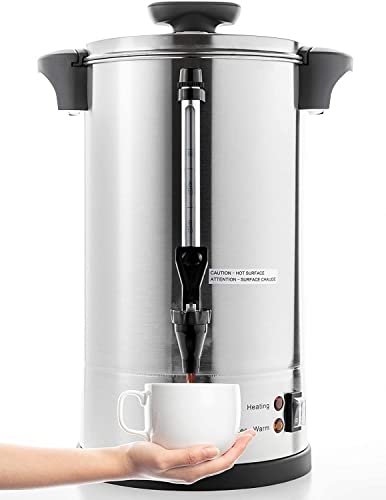
| Capacity | 100 cups (16 Liter / 4.2 Gallon) per brew |
| Voltage | 110-120 V |
| Material | Food grade 304 stainless steel body |
| Dispenser | Heavy-duty stainless steel spigot |
| Filtration | 304 stainless steel filter basket (no paper filters needed) |
| Warranty | 2 years new replacement warranty |
You spill coffee yet again because you’re pouring for a crowd and the urn on the counter just isn’t keeping up. The SYBO SR-CP-100B slides into service like a quiet workhorse, and you notice it from the first fill—304 stainless steel that gleams, with a sturdy spigot that doesn’t drip after you stop pouring.
It feels built for caterers who live in the rush of back-to-back cups.
Filling is almost comical in simplicity thanks to the interior water markings. You know exactly where to stop, exactly when to refill, and you’re not guessing at boil times.
The 60-minute window to brew 100 cups is real, not marketing fluff, so you can plan your service without scrambling for extra brews.
When it’s time to pour, the heat-and-keep-warm indicator light is a small-but-important nudge. It’s not flashy, but it’s honest—the coffee stays hot without you babysitting the urn.
The no-paper-filter setup surprises you with its easy cleanup and the stainless steel basket that feels built to survive daily use.
Physically, it’s a bit heavier than a typical home brewer, but that extra heft translates into stability on busy service days. The design stays lustrous despite frequent handling, and the safety shut-off gives you peace of mind in bustling environments like churches or care facilities.
In real-world use, it hits the two big needs: scale and simplicity. You get a large batch without fiddling with filters, and you don’t worry about running out mid-service.
If you’re pricing a catering setup, this urn feels like a reliable backbone rather than a flashy gadget.
Pros
Cons
- Heavy to lift
- Bulkier footprint
NUPANT 14-Cup Auto-Fill Commercial Airpot Coffee Brewer

- ✓ Fast 14-cup brew
- ✓ No hotplate needed
- ✓ Easy maintenance
- ✕ Size may be large
- ✕ Requires water line
| Capacity | 14 cups (3 minutes brew) |
| Hot Water Dispenser | Integrated hot water faucet with instant dispensing |
| Carafe/Pot Capacity | 2.2 Liters (74 oz) with double-wall vacuum insulation |
| Brew Temperature Range | 176–203°F (adjustable via digital control) |
| Control Interface | LCD digital panel with real-time display of temperature and cup size |
| Construction Material | Heavy-duty 304 stainless steel |
You’ve probably heard that commercial airpots are clunky, slow, and only useful for big cafes. Not this one.
It sits on the counter looking like a rugged, stainless-steel workhorse with a broad carafe that invites you to lift and pour.
In my hands, the 14-cup, 3-minute brew time feels almost too fast for a commercial unit. The 2.2-liter airpot is surprisingly compact, with a wide mouth that makes filling and cleaning a breeze.
No hotplate noise, no flickering lights—just consistent performance.
The digital LCD is refreshingly straightforward. You set the brew temperature between 176 and 203 F and choose 9, 12, or 14 cups.
It reads back the exact settings, which helps you dial in flavor without guesswork.
The plumbed water line is a game changer for busy environments. No more refills, and the built-in water filter helps keep flavors clean and true.
You’ll notice less scale buildup over time, which translates to fewer maintenance headaches.
Handling the airpot is another win. The double-wall vacuum carafe feels sturdy, and the lever spout makes pouring smooth, even when you’re juggling a line of orders.
The sprayhead and flat-bottom filter basket seem designed for faster extraction and richer flavor, which translates to cafe-quality coffee without the drama.
In everyday use, it shines in break rooms, events, and small catering gigs. It’s loud enough to know it’s working but not intrusive, and the 24-hour hot-keep is genuinely handy for late shifts or grab-and-go service.
Overall, this is a practical, reliable workhorse that bridges cafe quality with commercial resilience. If you need consistent batches, easy maintenance, and a true hot-water option, this unit delivers without drama.
Zulay Commercial Grade 100 Cup Coffee Maker Hot Water Urn –

- ✓ Heavy-duty build
- ✓ Easy pour faucet
- ✓ Big 100-cup capacity
- ✕ Heavy to move
- ✕ Heavier on upfront cost
| Capacity | 100 cups (5 oz each) per batch |
| Power Consumption (heat) | 1500 watts |
| Power Consumption (keep-warm) | 120 watts |
| Material | Double-wall 430 stainless steel outer, 304 stainless steel inner |
| Heating System | Concealed heating element with insulated dual-wall design |
| Faucet/Spout | Two-way easy pour faucet with single-cup or continuous pour option |
You won’t mistake this Zulay urn for a lightweight party prop. Right off the bat, it feels like a serious piece of equipment, with a double-wall stainless build that stays cool to the touch on the outside while the inside stays hot.
The first time you lift it, you’ll notice the weight in a good way, signaling durability you can trust for a busy catering day.
setup is straightforward: a twist-lock lid, easy-to-grip handles, and a camera-style viewing window that actually helps you gauge refills without pulling the urn out of service. The two-way faucet is handy, letting you pour a single cup or fill a carafe without juggling mugs.
It brews at a steady pace—about a cup per minute—so you’ll have a fresh pot ready as your meeting runs over.
In practice, the 100-cup capacity shines at larger events, weddings, or long conferences. The heat indicator light is a small but welcome detail, confirming when you should refill or switch to keep-warm.
The outer shell feels rugged enough for a hotel lobby or a bustling break room, and the concealed heating element does a solid job holding temperature through a couple of hours of service.
One thing to note: it’s not a lightweight weekend-warrior model. You’ll appreciate the cool-to-touch handles when you’re maneuvering it between rooms, and the lid locks in place to reduce accidental spills during transport.
If you’re lining up coffee for a crowd, this urn makes it feel less like a scramble and more like a polished, professional setup.
Overall, it’s a dependable workhorse for large gatherings, with a straightforward workflow that matches a busy day’s rhythm. If you need a high-capacity, durable coffee urn that delivers consistent warmth and ease of use, this Zulay is a strong fit.
What Specifications Make a Coffee Maker Commercial Grade?
The specifications that define a commercial grade coffee maker include durability, capacity, brewing speed, and advanced features.
- Durability: Commercial grade coffee makers are built with high-quality materials such as stainless steel and heavy-duty plastics that can withstand the rigors of daily use in busy environments. This ensures longevity and reliability, making them suitable for restaurants and cafes where they operate for long hours.
- Capacity: These coffee makers typically have larger water reservoirs and brewing capacities compared to home models, allowing them to brew several cups or pots of coffee at once. This is essential for meeting high demand during peak hours without compromising on the quality of the brew.
- Brewing Speed: Commercial grade machines are designed to brew coffee quickly, often featuring advanced heating elements and optimized brewing cycles that reduce wait times. This efficiency is crucial in commercial settings where speed can significantly impact customer satisfaction and service flow.
- Advanced Features: Many commercial coffee makers come equipped with programmable settings, multiple brew options, and temperature controls, allowing for customization based on customer preferences. Some models may also include built-in grinders or hot water dispensers, enhancing versatility and convenience in beverage preparation.
- Maintenance and Cleaning: These coffee makers often include features that simplify maintenance, such as removable brew baskets, easy access to internal components, and automated cleaning cycles. This is important for ensuring consistent performance and hygiene standards in a busy commercial kitchen.
How Does Brewing Capacity Impact Coffee Maker Selection?
Brewing capacity significantly influences the selection of a coffee maker, especially for commercial settings where demand can be high.
- Single-Serve Coffee Makers: These machines brew one cup at a time, making them ideal for small offices or low-traffic locations. While they offer convenience, they may not meet the demands of larger groups or high-volume settings, leading to longer wait times.
- Standard Drip Coffee Makers: Typically, these coffee makers have a brewing capacity ranging from 10 to 12 cups per cycle. They are suitable for medium-sized offices or cafes, providing a balance between speed and quantity, and allowing multiple servings to be brewed at once for group settings.
- Commercial Coffee Brewers: Designed for high-volume environments, these machines can brew several gallons of coffee per cycle. They often feature larger water reservoirs and can quickly refill coffee pots or airpots, making them perfect for busy restaurants or coffee shops that require a constant supply of fresh coffee.
- Batch Brewers: These machines brew large quantities of coffee at once, usually around 50 to 200 cups, and are ideal for events or busy service periods. They allow for the preparation of coffee in bulk, ensuring that there’s always a fresh supply available, which can be crucial during peak hours.
- Espresso Machines: While primarily focused on espresso, many commercial espresso machines can brew multiple shots quickly, making them suitable for cafes that require both espresso and drip coffee. Their ability to produce high-quality coffee quickly is essential in fast-paced environments.
Why is Coffee Quality Crucial When Choosing a Commercial Coffee Maker?
According to a study published in the Journal of Food Science, the extraction process during brewing is highly sensitive to factors such as water temperature, brew time, and the coffee grind size, all of which are directly impacted by the quality of the coffee maker. A well-designed commercial coffee maker can maintain optimal brewing conditions, thus ensuring that the flavors and aromas of high-quality coffee beans are fully realized (Hernández et al., 2020).
The underlying mechanism involves the interaction between water and coffee grounds. When brewing, water must be at an ideal temperature (usually between 195°F and 205°F) to extract the desirable compounds effectively. High-quality commercial coffee makers are engineered to achieve and sustain this temperature, as well as to control brew time and water flow, which ultimately affect the extraction yield. If a coffee maker compromises on these factors, even the best beans can result in a subpar cup of coffee, leading to customer dissatisfaction and potential loss of business.
What Varieties of Commercial Grade Coffee Makers are Available?
The varieties of commercial grade coffee makers available include:
- Drip Coffee Makers: These machines are designed for high volume brewing and can produce multiple cups of coffee at once, making them ideal for offices and cafes. They typically feature large water reservoirs and programmable settings for convenience.
- Single Serve Coffee Makers: These coffee makers allow for individual servings, offering the flexibility of brewing a fresh cup on demand. They often use pre-packaged coffee pods, which simplifies the brewing process and reduces cleanup time.
- Espresso Machines: These machines are specifically designed to brew espresso, often featuring steam wands for frothing milk, making them essential for coffee shops. They can range from manual to fully automatic models, catering to different skill levels and business needs.
- Pour Over Coffee Makers: Known for their ability to produce high-quality coffee, these devices require manual brewing techniques, allowing baristas to control every aspect of the brewing process. They are popular in specialty coffee shops where flavor precision is crucial.
- Cold Brew Coffee Makers: These machines are designed to steep coffee grounds in cold water for an extended period, resulting in a smooth and less acidic coffee. They are perfect for cafes that want to offer cold brew options during warmer months.
- Commercial Coffee Urns: Used primarily for large gatherings or events, these urns can brew and hold a significant quantity of coffee at a consistent temperature. They are ideal for buffets, parties, and corporate events where a large volume of coffee is needed quickly.
What Are the Differences Between Automatic and Manual Coffee Makers?
| Aspect | Automatic Coffee Makers | Manual Coffee Makers |
|---|---|---|
| Functionality | Automatically brews coffee with minimal user input, often with programmable settings. | Requires hands-on operation, allowing for a more personalized brewing process. |
| Ease of Use | Very user-friendly, ideal for quick preparation and convenience. | Can be more complex, requiring practice and technique to master brewing. |
| Control | Limited control over brewing parameters, mostly preset by the machine. | Full control over brewing time, temperature, and coffee-to-water ratio. |
| Price | Generally more expensive due to advanced features and automation. | Usually less expensive, offering a range of budget-friendly options. |
| Brewing Speed | Typically brews coffee quickly, often within minutes. | Brewing time can vary significantly based on the method used. |
| Maintenance Requirements | Usually requires less regular maintenance, with features like self-cleaning. | Often requires more frequent cleaning and attention to detail. |
| Coffee Quality | Consistent quality due to automated parameters, but may lack depth. | Tends to produce richer flavors, allowing for experimentation. |
| Size and Portability | Usually bulkier and designed for stationary use. | Often more compact and can be portable depending on the design. |
| Ideal Use Cases | Great for busy environments and quick service. | Best for coffee enthusiasts who enjoy the brewing process. |
How Do Drip Coffee Makers and Espresso Machines Compare for Commercial Use?
| Feature | Drip Coffee Maker | Espresso Machine |
|---|---|---|
| Brewing Method | Uses hot water to drip through coffee grounds for a smooth brew. | Forces hot water through finely-ground coffee for a concentrated shot. |
| Speed | Generally slower, can take several minutes for a full pot. | Faster, can produce a shot in about 25-30 seconds. |
| Capacity | Typically brews multiple cups at once, suitable for larger groups. | Usually brews one or two shots at a time, less volume. |
| Flavor Profile | Produces a milder flavor, ideal for drip coffee enthusiasts. | Creates a rich, intense flavor, preferred for espresso drinks. |
| Price Range | $30 – $300, depending on features and brand. | $100 – $3000, depending on type and features. |
| Maintenance Requirements | Requires regular cleaning; simpler maintenance. | More complex; requires regular descaling and part replacement. |
| Versatility in Beverage Options | Primarily brews coffee, limited to types of coffee. | Can make various drinks including lattes, cappuccinos, and more. |
| User Skill Level Required | Easy to use, suitable for all skill levels. | Requires some skill and knowledge for optimal results. |
| Best Use Case Scenarios | Ideal for offices, diners, and casual settings. | Best for cafes, coffee shops, and specialized coffee venues. |
What Should You Know About Maintenance and Durability of Coffee Makers?
When considering the maintenance and durability of coffee makers, especially in a commercial setting, several key factors come into play:
- Build Quality: The materials used in the construction of a coffee maker greatly affect its durability. Commercial-grade coffee makers are typically made from stainless steel or high-quality plastics that withstand heavy use and resist corrosion, ensuring a longer lifespan.
- Maintenance Requirements: Regular maintenance is essential for the longevity of coffee makers. This includes descaling to prevent mineral buildup, cleaning the brew basket and carafe, and checking for wear and tear on seals and gaskets, which can affect performance over time.
- Warranty and Support: A solid warranty is a sign of a manufacturer’s confidence in their product. Commercial-grade coffee makers often come with extended warranties and customer support, which can be invaluable for troubleshooting issues and obtaining replacement parts.
- Ease of Repair: Some coffee makers are designed with repair in mind, featuring modular components that can be easily replaced. This is crucial in a commercial setting where downtime can lead to lost revenue; being able to quickly service or replace parts ensures minimal disruption.
- Performance Consistency: A durable coffee maker should provide consistent brewing temperatures and timings. Variability can not only affect the flavor but can also lead to increased wear, requiring more frequent repairs and maintenance.
- Energy Efficiency: A coffee maker that is energy efficient not only saves on utility costs but also tends to have a more robust design and components that are built to last longer under consistent use.
How Do Prices Vary Among Commercial Coffee Makers, and Are They Worth the Investment?
Prices for commercial coffee makers can vary significantly based on features, capacity, and brand, leading to a wide range of options for different business needs.
- Single-Serve Coffee Makers: These machines typically range from $100 to $500 and are ideal for small offices or cafes that require quick coffee service without the need for large quantities. They often use pods or capsules, making them convenient but potentially more expensive per cup compared to bulk brewing methods.
- Drip Coffee Makers: Ranging from $200 to $2,000, these machines are popular in both small and large-scale settings. They can brew large quantities of coffee at once, with some models featuring programmable settings and built-in grinders for a fresh brew, appealing to those who prioritize flavor and efficiency.
- Commercial Espresso Machines: These machines can cost between $1,000 and $20,000 depending on their complexity and capabilities, such as multiple group heads and automatic features. They are essential for cafes and restaurants focused on espresso-based beverages, offering high-quality extraction and consistency for baristas.
- Pour-Over Coffee Makers: Prices for these machines typically range from $100 to $800, making them a cost-effective option for specialty coffee shops. They allow for manual brewing control, which appeals to coffee aficionados seeking to highlight the unique flavors of different beans.
- Batch Brewers: These machines can range from $500 to $3,000 and are designed for high-volume brewing, making them suitable for busy cafes or catering businesses. They often feature advanced technology for temperature control and brew time, ensuring optimal flavor extraction for large quantities of coffee.
- Commercial Coffee Grinders: Prices can vary from $200 to $2,000, and they are essential for any coffee operation that values freshness. Quality grinders ensure even extraction and can significantly enhance the flavor profile of the coffee, making them a worthwhile investment for serious coffee businesses.